htl-manure-lca
Aspen Plus models
These files document the three Aspen Plus flowsheets of the thesis so they can be rebuilt, reviewed or reproduced. They are not Aspen Plus files (.bkp / .apw). Those can only be produced by Aspen Plus itself. If you have the original simulation files, add them to this folder.
| File | Contents |
|---|---|
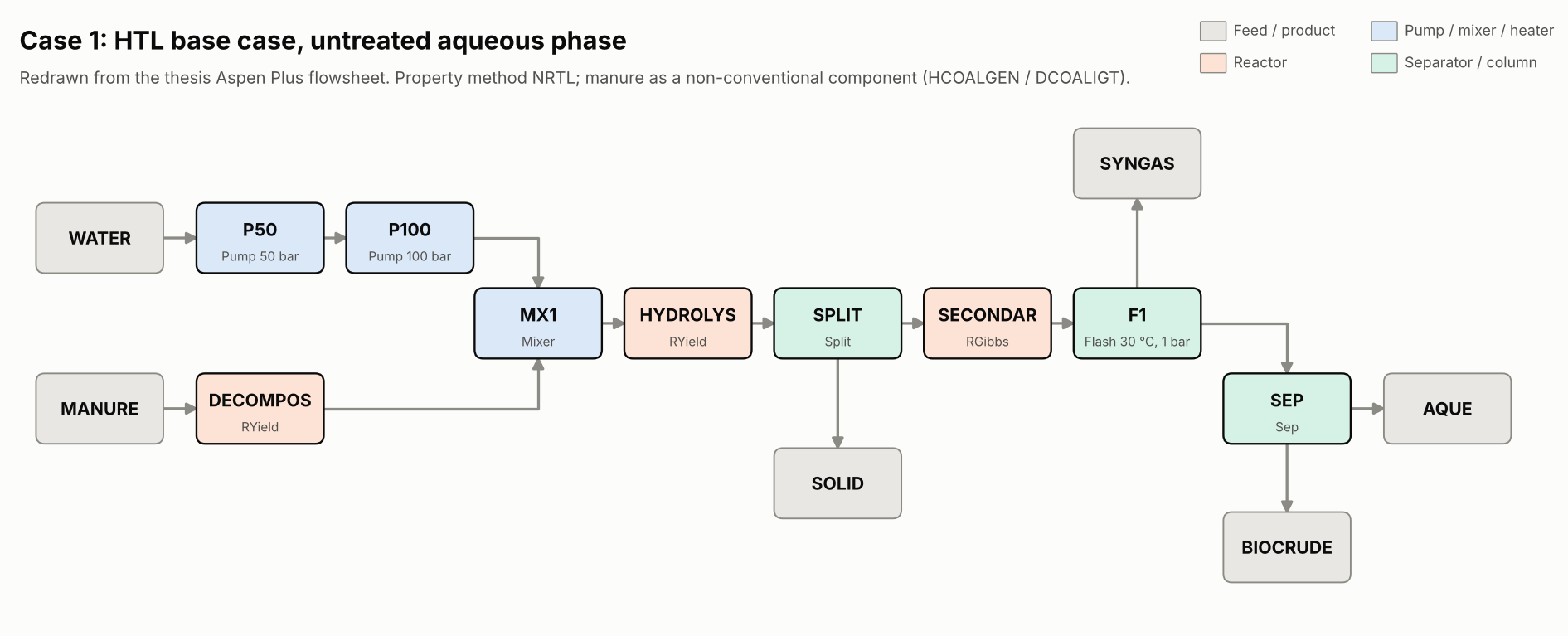
flowsheet_case1.png |
Case 1: HTL base case, untreated aqueous phase (thesis Fig 3.2) |
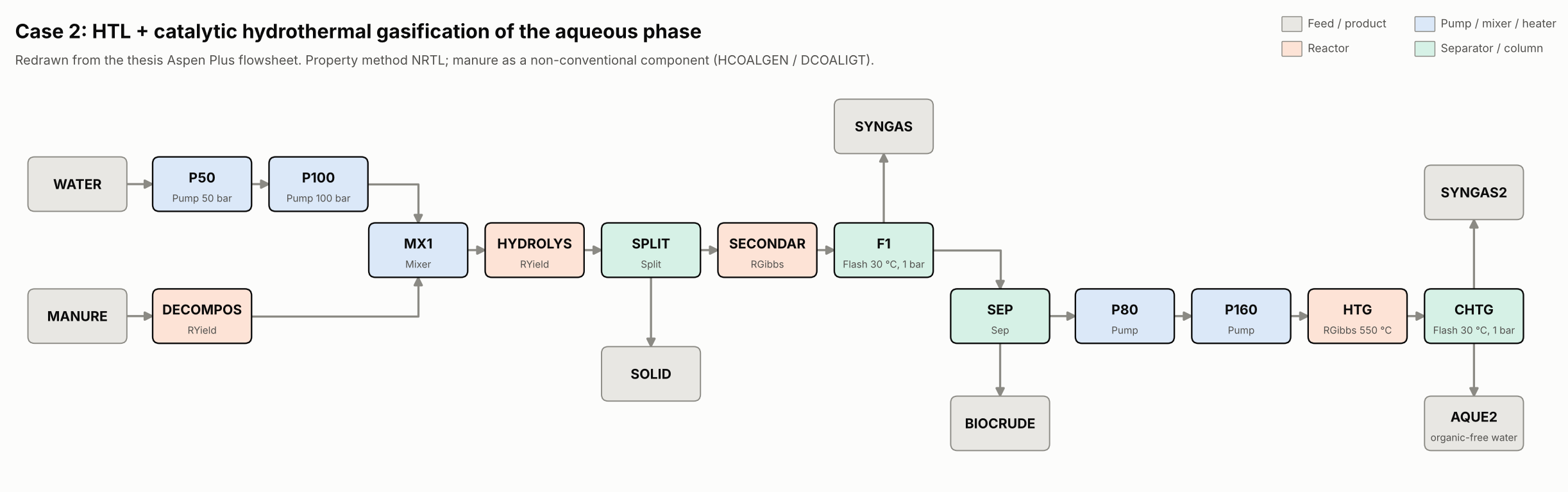
flowsheet_case2.png |
Case 2: HTL + catalytic hydrothermal gasification (thesis Fig 3.3) |
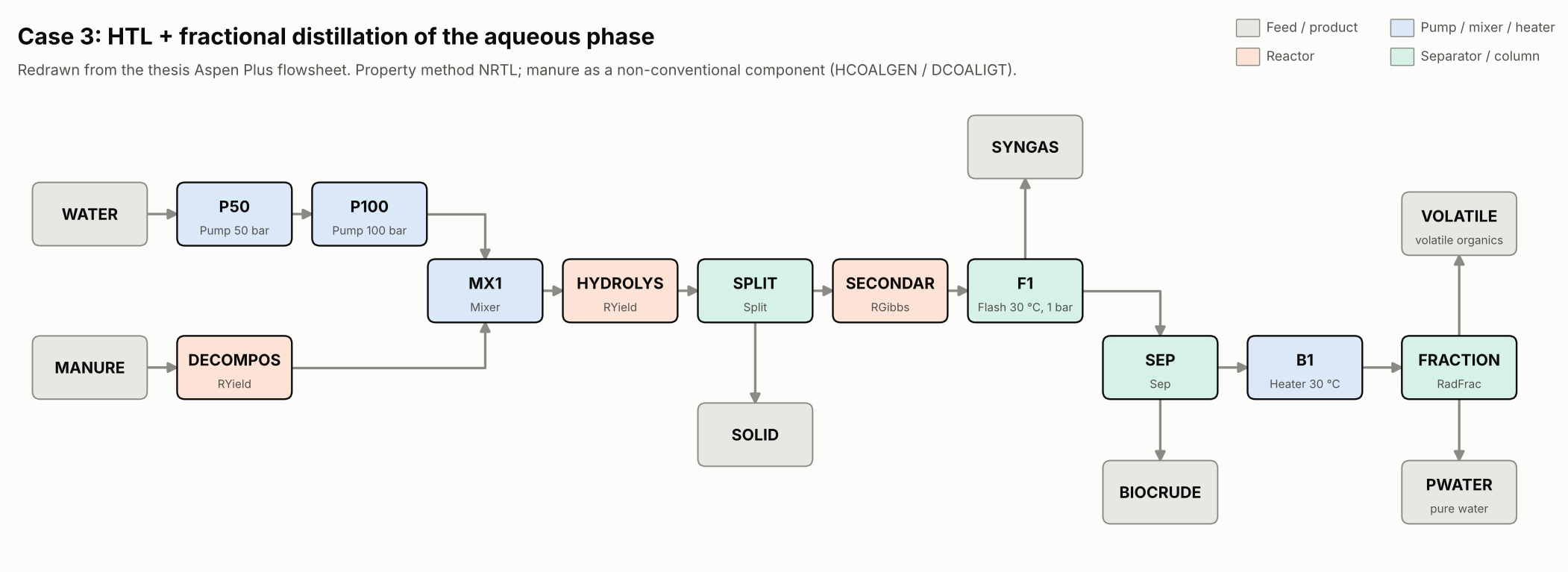
flowsheet_case3.png |
Case 3: HTL + fractional distillation (thesis Fig 3.4) |
blocks.csv |
Every unit operation: Aspen model, role, inlet and outlet streams, conditions |
streams_case1.csv |
Stream table for the base case (kg/h) |
decompos_calculator.f |
Fortran calculator for the DECOMPOS RYield block (thesis Table 3.2.1) |
draw_flowsheets.py |
Redraws the three flowsheet PNGs |
Model set-up
| Setting | Value |
|---|---|
| Property method | NRTL |
| Manure | Non-conventional component, defined by PROXANAL, ULTANAL and SULFANAL |
| Enthalpy / density of manure | HCOALGEN / DCOALIGT (coal correlations) |
| Feed | 2,000 t/day wet manure (83,333 kg/h), 78.76% moisture |
| Slurry | 20 wt% dry solids (5,167 kg/h make-up water) |
| HTL | 350 °C, 100 bar (Table 3.2.2); SECONDRY RGibbs at 300 °C, 175 bar (Section 3.2) |
| Product separation | Flash F1 at 30 °C, 1 bar; SEP splits biocrude from the aqueous phase |
| Assumptions | Steady state, isothermal, no pressure losses, no kinetics (yield reactors), fixed biocrude composition, no particle-size distribution |
Case 2: catalytic hydrothermal gasification (CHG)
The aqueous phase is pumped to 200 bar and gasified at 550 °C in an RGibbs reactor (100% conversion of organics to CH₄, CO₂ and NH₃, 99.9% COD removal). It is then flashed at 30 °C and 1 bar into CHG off-gas (≈77% CO₂) and organic-free water.
Case 3: fractional distillation (RadFrac)
The aqueous phase (COD 650 mg/L) is heated to 30 °C and fed to a RadFrac column. The column has 6 theoretical stages, a molar reflux ratio of 1 and a bottoms rate of 70,259.5 kg/h. The bottoms are water with 99.974 mol% purity and COD < 250 mg/L; the top product is volatile organics, mostly CO₂.
Rebuilding in Aspen Plus
- Components: H2O, C (solid), H2, O2, N2, S, CO, CO2, CH4, NH3, H2S, the biocrude model compounds, and non-conventional MANURE and ASH.
- Enter the manure analysis from
../data/thesis_tables/manure_analysis_aspen_input.csv. - Add the blocks and streams from
blocks.csv, then the DECOMPOS calculator fromdecompos_calculator.f. Include the sulfur line, so the yields sum to 1. - Set HYDROLYS yields so that the products match
../data/thesis_tables/mass_balance_aspen.csv.
The Python model in ../src/htlmodel/mass_balance.py reproduces these mass balances exactly and can be scaled to other feed rates.